Short-Term Rentals
Summit County Short-Term Rental Rules, by Town
In Summit County, the short-term-rental rules are often the single biggest variable in what a property is worth to own. Every jurisdiction sets its own caps, waitlists, and fees, and most are at or over cap. This is the plain-English map of where you can still rent, where you can't, and what to verify before you count on the income.
The Short Answer
Can You Short-Term Rent in Summit County?
Usually yes, but where and whether you can get a license is now the real question. Almost every basin and most town zones have hit their cap, so the license, not the house, is often the scarce asset. In the tightest areas no new licenses are available at all, and in Breckenridge and most towns the license doesn't transfer when a home sells, so a buyer starts over.
That makes one question decisive before you buy for rental income: does this exact parcel carry, or still qualify for, a license. It's knowable, it's parcel-specific, and it belongs in the underwriting from day one. The map below is where to start; I confirm the current status for a specific address as part of any purchase.
At a Glance
Summit County STR Rules by Jurisdiction
A working summary as of 2026. Caps and waitlists move through the year, so treat this as the starting point and confirm the current figures with the jurisdiction and at contract.
| Jurisdiction | Cap | Status | Waitlist | Annual Fee | Transfers on Sale |
|---|---|---|---|---|---|
| Breckenridge (Resort & Zone 1) The two zones where you can still get a license without waiting. | Zone 1: 1,680 | Licenses available (Zone 1: 467 open, July 2026) | No waitlist | $756 / bedroom / yr + BOLT | No |
| Breckenridge (Zone 2 & Zone 3) Downtown core and residential. Zone 3 carries 1,002 grandfathered licenses against a 390 cap, and none transfer on sale. | Zone 2: 130 / Zone 3: 390 | Full | Waitlist | $756 / bedroom / yr + BOLT | No |
| Unincorporated County (Resort Overlay) Copper Mountain, Tiger Run Resort, and sections of Peak 7 and Peak 8. No limit on nights rented. | No cap | Open | No waitlist | $295 / yr | No (narrow family and entity exceptions) |
| Unincorporated County (Neighborhood Overlay) 35 bookings a year. A Type I exception ($240 / yr) sits outside the cap but needs a Qualified Occupant. | Capped by basin | Upper Blue 563 of 590, Lower Blue 508 of 550; Snake River and Ten Mile over cap (Jan 2026) | Upper Blue, Lower Blue, Snake River | $360 / yr (Type II) | No (narrow family and entity exceptions) |
| Frisco One of the shorter waitlists in the county as of early 2026. | 25% of housing stock (~900) | Cap reached | ~12 to 14 months | Town schedule | No |
| Silverthorne Area 3 (deed-restricted) bans STRs. Ruby Ranch, Hamilton Creek, Wildernest, and Mesa Cortina are unincorporated county, not town. | Area 1: 10% / Area 2: 50% of approved units | Open in both areas (Area 1: 22 left, Aug 2026) | None yet | $150 to $500 / yr by bedrooms | No |
| Dillon (town) The most permissive town in the county. Nearby unincorporated parcels are capped, so confirm the parcel. | No cap | Open | No waitlist | Town schedule | Confirm |
| Blue River New-license and renewal moratorium in effect through at least Dec 31, 2026 pending an ordinance rewrite. The board is still evaluating a cap. | No cap set yet | Moratorium | Paused | $300 / bedroom / yr + application | No |
| Keystone (new town) Resort Overlay Zone. The newly incorporated town hasn't capped licenses, for now. | No cap | Open | No waitlist | ~$285 / yr | No |
BOLT = Breckenridge Business & Occupational License Tax. Figures reflect early-to-mid 2026 and are directional; verify current caps, availability, and fees with each jurisdiction.
Breckenridge
How Do Breckenridge's STR Zones Work?
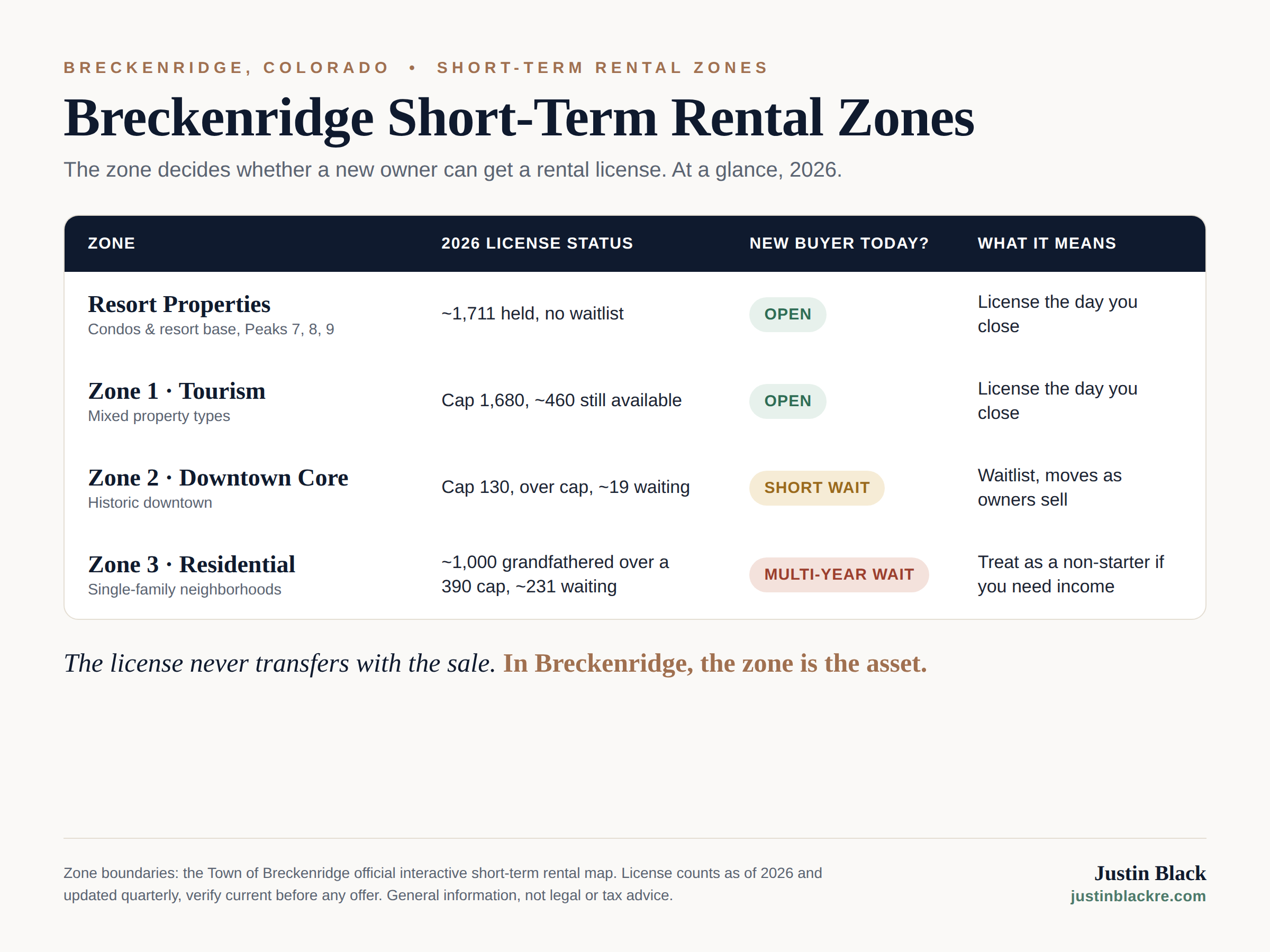
Breckenridge splits the town into four license zones, and which one a home sits in decides almost everything. The Resort Zone and Zone 1 (tourism) still have licenses available with no waitlist. Zone 2 (the downtown core) and Zone 3 (single-family residential) are at cap, and both run waitlists. As of the Town's July 2026 counts, Zone 1 had 467 of its 1,680 licenses still available. Zone 2 is capped at 130 with all 130 issued, and Zone 3 is capped at 390 but carries 1,002 grandfathered licenses, so no new licenses are available there.
Existing Zone 3 licenses are grandfathered, which sounds reassuring until you learn they don't transfer on sale. When a licensed home changes hands, the license is surrendered and the buyer applies fresh at the back of the line. So a home marketed as a proven rental may convey with no transferable right to rent it at all.
Because eligibility comes down to the exact parcel and zone, the zone map is the first thing to check. I break down which areas fall in which zone, and what that means for a buyer, in this companion guide: Breckenridge Short-Term Rental Zones, by area.
Unincorporated County
What Are the Rules Outside the Towns?
A Breckenridge, Frisco, or Silverthorne mailing address doesn't mean a town makes the rules. Property outside the incorporated towns falls under Summit County's own program, which splits into two overlay zones. If an address doesn't come up on a town's STR map, check the county's STR mapping tool instead.
The Resort Overlay Zone is uncapped, with no waitlist, so a buyer can license after closing. The county lists Copper Mountain, Tiger Run Resort, and sections of Peak 7 and Peak 8 in Breckenridge. The license runs $295 a year with no limit on nights rented. Boundaries are drawn parcel by parcel, so confirm the specific address rather than assuming from the neighborhood.
Everything else residential sits in the Neighborhood Overlay Zone, capped basin by basin for the standard investor license, called Type II ($360 a year). As of the county's January 2026 counts, the Upper Blue Basin around Breckenridge had 563 of 590 licenses issued and the Lower Blue around Silverthorne had 508 of 550, and the county has since issued more from its waitlists: 26 in Upper Blue and 41 in Lower Blue during 2026. The county's posted Upper Blue waitlist, dated January 22, 2026, runs to 119 entries. Snake River (137 of 130) and Ten Mile (24 of 20) were over their caps. Neighborhood-zone licenses are also limited to 35 bookings a year, counted as reservations, not nights.
So a Type II license in a neighborhood zone is a waitlist play, not a day-one one. Joining the county waitlist costs a $75 non-refundable fee and is open only to current owners, so you can't hold a place while you're under contract. There are a few legitimate ways around the cap, which I cover below.
Frisco
Can You Short-Term Rent in Frisco?
Frisco caps short-term rentals at roughly 25 percent of its housing stock, about 900 licenses, and that cap has been reached. New applicants join a waitlist that has run in the range of twelve to fourteen months, which makes it one of the shorter waits in the county but a wait nonetheless. As with the towns around it, plan on the license not conveying with a sale, and verify the current queue before you count on rental income. For the full 2026 rules, the Frisco-address trap, and where a new license is still available nearby, see Frisco short-term rental rules. The nearest place you can still get a new license on demand is Copper Mountain, in the county's uncapped Resort Overlay Zone.
Silverthorne
What About Silverthorne?
Silverthorne regulates by area, and the cap is measured across the whole area, not neighborhood by neighborhood. Area 1, which covers most of the town's neighborhoods, caps short-term rentals at 10 percent of approved units. Area 2, the Town Core and Riverfront, allows up to 50 percent. As of the Town's August 2026 count, Area 1 had 22 licenses left and Area 2 had 294, so neither had a waitlist yet, though Area 1 is close. Area 3, the deed-restricted workforce housing, bans short-term rentals outright. Several neighborhoods with Silverthorne addresses, including Ruby Ranch, Hamilton Creek, Wildernest, and Mesa Cortina, sit in unincorporated county and fall under the capped Lower Blue Basin instead. The full breakdown, neighborhood by neighborhood, is in Silverthorne short-term rental rules.
Dillon
Is Dillon the Easiest Place to Short-Term Rent?
Among the incorporated towns, yes. The Town of Dillon currently runs no cap and no waitlist, which in a county where nearly everywhere else is full is a meaningful advantage, and one worth pricing in. The one caveat is the boundary: parcels just outside town in the Snake River Basin fall under the county's capped overlay, so confirm a property is actually inside town limits.
Dillon's posture is also worth reading, not just its rules. The town has publicly described STR owners as community stakeholders rather than a problem to be managed, which tends to signal a steadier regulatory footing. I unpack why that language matters for underwriting here: Dillon calls STR owners community stakeholders. For the full 2026 rules, the flat $700 fee, and the address trap, see Dillon short-term rental rules.
Blue River
What's Happening With Blue River's Moratorium?
Blue River historically ran no cap and no waitlist, which made it an easy answer for years. That changed in 2026: the town enacted a moratorium on new licenses and renewals, in effect through at least December 31, 2026 while it rewrites its ordinance. Until the new rules land, treat Blue River as paused rather than open, and watch for what the rewrite sets as the new baseline. The Town's own rules page says the board hasn't set a cap and is still evaluating one. Its 2026 fee schedule charges $300 per bedroom a year plus a $300 application fee (or $200 to renew), licenses expire every December 31, and a holder has to rent at least 10 days a year to keep one. For the full moratorium timeline, why the town froze licensing, and what it means for buyers, see Blue River short-term rental rules.
Keystone
Can You Short-Term Rent in Keystone?
Keystone is the wild card, in a good way for owners. As Colorado's newest incorporated town it hasn't yet capped short-term rentals, and its Resort Overlay Zone runs no cap and no waitlist, with a license around $285 a year. That combination, brand-new luxury base village plus open rental rules, is rare in this county. Because the town is new, its rules could evolve, so it's the one place I watch most closely. More on the new town and its base-village shift: Keystone becomes a town, and Kindred raises the base. The full rules, the flat $285 fee, and how Keystone compares are here: Keystone short-term rental rules.
The Part Most Buyers Miss
Does the License Transfer When You Sell?
In Breckenridge and most Summit County jurisdictions, no. The license is surrendered when the home sells and the new owner reapplies, at the back of the waitlist if there's one. In a market this capped, that single fact reshapes how a rental-capable home should be valued and how a deal should be structured, because the buyer is often not buying a rental, they're buying a house and a lottery ticket.
The clearest way to think about it is that the license has become a separate asset, and most buyers still aren't pricing it in. I make that case in full here: The STR license is the asset. And if you're weighing whether the numbers work at all, this is the underwriting framework I use: the honest math on a Colorado vacation rental.
The Pathways Most Buyers Miss
Is There Any Way to Rent in a Capped Area?
Sometimes. A capped basin isn't always the end of the story, and almost no one selling you a home will walk you through these.
The Type I Resident-Occupied License
The county's waitlist only applies to Type II. A separate Type I license is an exception to the basin cap, so there's no waitlist, and it runs $240 a year. The catch is the occupancy rule: the home has to be lived in by a Qualified Occupant, an owner or long-term renter who makes it their primary residence, lives on site at least nine months a year, and works at least 30 hours a week in Summit County. That can be you, if you live and work here, or a local tenant. When the Qualified Occupant is temporarily away, the holder can rent the whole home, still within the 35-booking limit and the occupant's nine-month residency. Two catches the county has confirmed: a Type I gives you no standing toward a Type II license later, and if your Qualified Occupant stops qualifying, the license simply ends. It's built to keep a local in the home, so it isn't an out-of-state investor's tool, but for the right buyer it's a way into a capped basin that the waitlist never touches.
Lock-Offs and ADUs
A walkout lower level, a lock-off, or an accessory dwelling unit can open options a single unit doesn't, but the paperwork decides it, not the floor plan. Whether a secondary space can be rented, and to whom, turns on the unit's permit and its recorded covenant. County ADUs are restricted to a Qualified Occupant or a relative of the owner, and the county reimburses up to $60,000 toward building a new ADU in unincorporated areas. Never assume a lower level means rental income. Pull the permit and the covenant on the specific home first.
Renting for 30 Days or More
The simplest path needs no license at all. A rental of 30 consecutive days or more isn't a short-term rental, and in a market this short on workforce housing, a long-term lower level or ADU rents easily. Blue River draws the line one day later: its license covers rentals of 30 days or less, so a lease there needs to run longer than 30 days.
For a whole furnished home, the demand is mostly seasonal. In mid-October 2026, furnished three- and four-bedroom homes around Breckenridge and Blue River were asking roughly $4,000 to $7,800 a month on Zillow, and the strongest listings were ski-season leases running about November or December through April or May. A few year-round furnished listings had been sitting for weeks or had cut their price. Treat those as asking rents, not signed leases.
Before You Write an Offer
How Do You Check a Specific Property?
- Confirm the jurisdiction. Search the address on the town's STR map, such as the Breckenridge interactive map. If it doesn't come up, it's likely unincorporated county, so check the county's STR mapping tool and the County Assessor.
- Find the zone or basin and its status: open, capped with a waitlist, or effectively closed.
- Assume the seller's license doesn't come with the house, and price the home on what you can license, not on its rental history.
- If it's capped, look at the layout and the covenants for a Type I or long-term path.
- Read the HOA covenants. A town or the county can allow short-term rentals while an HOA restricts or bans them. Zoning and covenants are two separate gates, and you have to clear both.
- Verify with the governing office before you write the offer, since the counts move through the year.
Common Questions
Summit County STR Questions
Can you still short-term rent in Breckenridge in 2026?
Yes, but only in some zones. The Resort Zone and Zone 1 still have licenses available with no waitlist. Zone 2 (the downtown core) and Zone 3 (single-family residential) are at cap with multi-year waitlists, so a home there can be short-term rented only if it already holds a grandfathered license, and even then the license is surrendered when the home sells. Confirm the specific zone before you rely on rental income.
Which Summit County town is easiest to get an STR license in?
The Town of Dillon currently has no cap and no waitlist, which makes it the most permissive incorporated town. Keystone, newly incorporated, also has no cap yet, and the county's Resort Overlay Zone (Copper Mountain, Tiger Run, and sections of Peak 7 and Peak 8) is uncapped. Silverthorne still had licenses available in both of its areas as of August 2026, though Area 1 is close to its cap. Breckenridge Zones 2 and 3, Frisco, and the county's neighborhood zones run waitlists. Rules can change quickly, so treat this as a starting point and verify at contract.
Does a Summit County STR license transfer when the home sells?
In Breckenridge and most jurisdictions, no. The license is surrendered on sale and the buyer must apply fresh, joining the back of any applicable waitlist. The county and Silverthorne allow narrow exceptions, such as transfers into the owner's own trust or LLC, inheritance, or a divorce decree, but an ordinary sale doesn't carry the license. That's why, in a capped market, the license is best understood as a separate asset rather than something that automatically comes with the house.
What's a Neighborhood Overlay Zone in unincorporated Summit County?
It's the county's framework for regulating short-term rentals outside the incorporated towns and outside its uncapped Resort Overlay Zone, applied by basin (Upper Blue, Lower Blue, Snake River, and Ten Mile). Type II licenses, the standard investor license, are capped by basin. As of January 2026, Snake River and Ten Mile were over their caps, and Upper Blue, Lower Blue, and Snake River all ran waitlists. Neighborhood-zone licenses are limited to 35 bookings a year. A Type I license is an exception to the cap that requires a Qualified Occupant, so it doesn't fit a pure second-home or investment use.
How much does a Summit County short-term rental license cost?
It depends on the jurisdiction. Breckenridge charges $756 per bedroom per year plus a business and occupational license tax, so a larger home runs into the thousands annually. Unincorporated Summit County charges $360 a year for a Type II license, $295 in the Resort Overlay Zone, and $240 for a Type I. Silverthorne runs $150 to $500 a year depending on bedrooms. Blue River's 2026 schedule is $300 per bedroom a year plus a $300 application or $200 renewal fee, and Keystone runs about $285 flat. Confirm the current fee schedule with the jurisdiction, since these are updated regularly.
What taxes apply to a short-term rental in Summit County?
A short-term rental collects state, county, and town sales tax plus applicable lodging or marketing taxes, with the exact combined rate depending on the property's jurisdiction. Airbnb and VRBO collect and remit most of these automatically, but direct bookings are the owner's responsibility. Confirm the current combined rate for your specific address before you underwrite the income.
What's a Type I short-term rental license in Summit County?
It's the county's resident-occupied exception license in unincorporated areas. It isn't counted under the basin cap, so there's no waitlist, and it runs $240 a year. The tradeoff is that the home must be occupied by a Qualified Occupant: an owner or long-term renter who makes it their primary residence, lives on site at least nine months a year, and works at least 30 hours a week in Summit County. It's still limited to 35 bookings a year and gives no standing toward a future Type II license.
Can you short-term rent an ADU in unincorporated Summit County?
Usually not as a nightly rental. County accessory dwelling units are restricted to a Qualified Occupant or a relative of the owner, and the recorded covenant on the specific unit is what governs, so read it property by property. A rental of 30 consecutive days or more isn't a short-term rental and needs no license.
Buying for the Rental Income? Get the License Question Answered First.
Before you write an offer on a home you plan to rent, the license status of that exact parcel should be settled, not assumed. I run that check as part of any purchase, and I keep track of which capped-area homes still carry a transferable-in-practice advantage. Tell me what you're trying to do and I'll tell you where it actually works.
Choosing between towns first? Start with the Summit County town comparison or the second-home buyer's guide.