
If you're buying in Breckenridge with rental income in the plan, the first question isn't what the home costs. It's which of the Breckenridge short-term rental zones it sits in. The town sorts every address into one of four zones, and the zone decides whether you can get a rental license at all, whether you wait years for one, and how much that right is worth. A home that rented beautifully for the last owner can be off-limits to you the day after closing. Here's how the zones work and how to shop by them. For how Breckenridge fits the wider county picture, see the Summit County short-term rental rules by town.
Breckenridge short-term rental zones map
The Town of Breckenridge publishes an official interactive short-term rental zones map. Type any address into it and it returns that property's zone, Resort, Zone 1, Zone 2, or Zone 3, which is the single fact that decides whether a new owner can rent it. Confirm the zone there before you trust any listing's rental history. Here's what each zone means for a buyer at a glance:
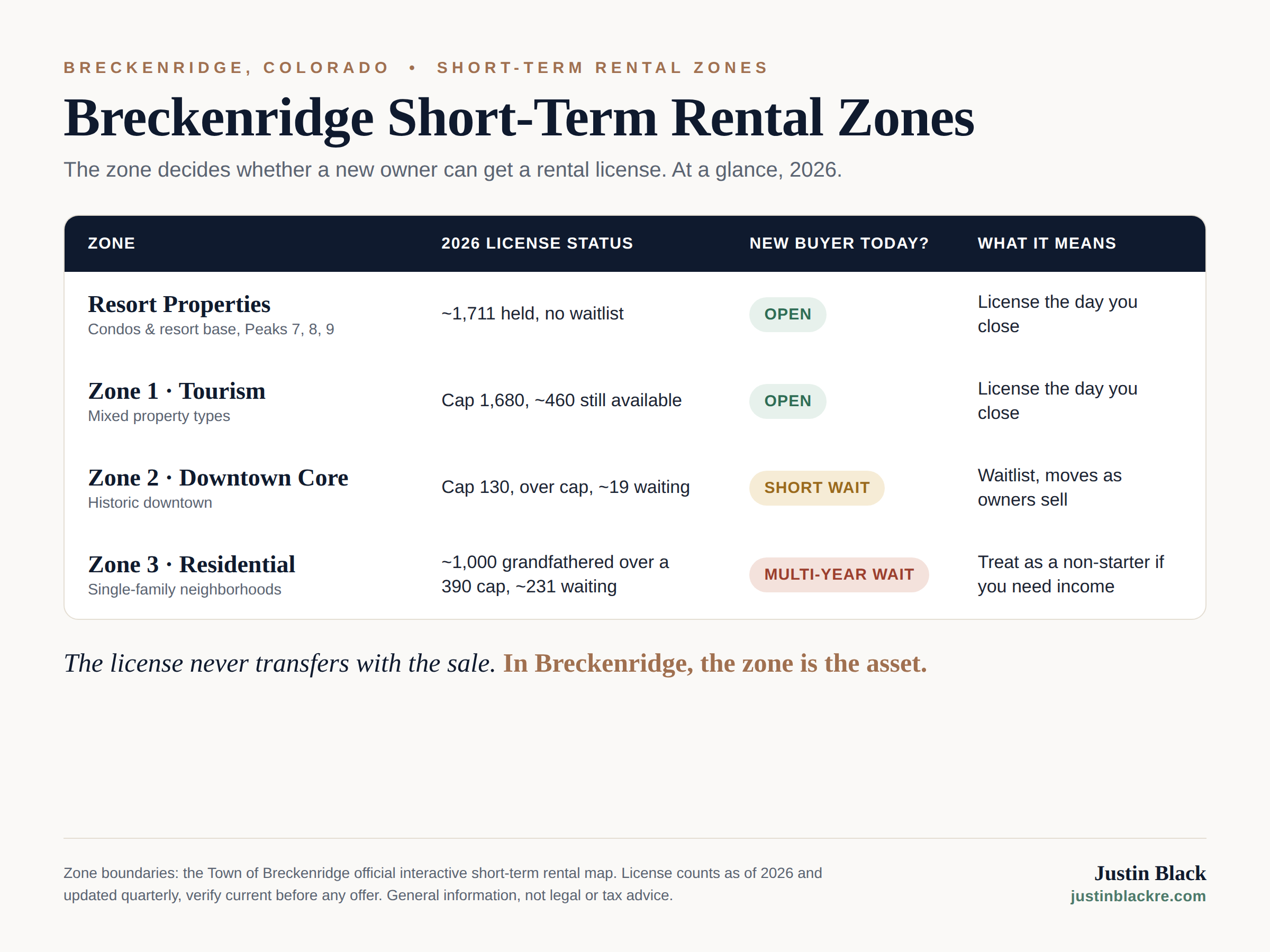
| Zone | Where it's | 2026 license status | Can a new buyer license today? |
|---|---|---|---|
| Resort Properties | Condo and resort-base properties around Peaks 7, 8, and 9 | About 1,711 held, no waitlist | Yes, apply the day you close |
| Zone 1, Tourism | A mix of property types with high license eligibility | Cap 1,680, roughly 460 still available, no waitlist | Yes, apply the day you close |
| Zone 2, Downtown Core | The historic downtown core | Cap 130, over cap, about 19 on the waitlist | Short wait |
| Zone 3, Residential | The single-family neighborhoods | Roughly 1,000 grandfathered against a 390 cap, about 231 on the waitlist | Multi-year wait, treat as a non-starter if you need income |
Can you short-term rent any home in Breckenridge?
No. Two things have to line up. The town has to allow a license for that property's zone, and you have to actually obtain one. Any property rented for fewer than 30 consecutive days inside town limits needs an Accommodation Unit License before it can be advertised or booked. The detail most buyers miss: the license is tied to the owner, not the address, and it doesn't transfer when the property sells. A listing that markets a strong rental history is describing the previous owner's license, not a guarantee for you.
What are the four Breckenridge short-term rental zones?
The town capped licenses in late 2021 and drew four zones in 2022, each with its own cap and its own waitlist. The caps are designed to hold Zones 1 through 3 under a combined ceiling of about 2,200 licenses. From most rentable to most restricted:
Resort Properties Zone. The condo complexes and resort-base properties built for tourism, concentrated around the Peak 7, Peak 8, and Peak 9 base areas. This is the open lane. There's no waitlist and licenses remain available. The town reported roughly 1,711 licenses held here as of mid-2026.
Zone 1, the Tourism Zone. A mix of property types where a high share of homes can hold a license. The cap is 1,680, and only about 1,220 were held, so roughly 460 licenses are still available with no waitlist.
Zone 2, the Downtown Core. Capped at 130 licenses. It sits over its cap because of grandfathered properties, so new applicants join a waitlist. That waitlist was short, around 19 people, as of early 2026.
Zone 3, the Residential Areas. The single-family neighborhoods. Capped at 390 and far over cap, with roughly 1,000 licenses grandfathered above the ceiling, so no new licenses are issued. The waitlist ran about 231 people as of early 2026, with no published timeline and waits expected to span years.
Which Breckenridge zones can you actually get a license in right now?
For a buyer who needs rental income to pencil, the answer is short: the Resort Properties Zone and Zone 1. Both currently issue licenses with no waitlist, which means you can apply the day you close and have a license in hand. Zone 2 means a short wait. Zone 3 means a multi-year wait that moves only when an existing owner sells or fails to renew, since licenses are released only through attrition. If your purchase depends on short-term rental income, Zone 3 is generally not a fit. Confirm a property's zone before you write the offer using the town's interactive zone map, because the zone, not the listing photos, decides your path.
Why doesn't the short-term rental license transfer when you buy?
This is the most expensive misunderstanding in Breckenridge rental buying. Licenses are non-transferable. When a licensed rental sells, the license is relinquished, and the new owner has to apply fresh and qualify under the current cap and waitlist for that zone. In the open zones that's a quick formality. In Zone 2 or Zone 3 it can mean buying a proven rental and then being unable to legally rent it for years. It's also why the ability to license is itself a priced asset. In the Resort Zone and Zone 1, for-sale homes often carry a premium because the buyer is paying for a clear licensing path. We go deeper on that in why the STR license is the real asset.
You also can't apply before you own the property. Only the deed holder can apply or join a waitlist, but you can apply the same day you close, so there's no reason to wait.
What does a Breckenridge short-term rental license cost to hold?
Two annual fees, both based on bedroom count, not property value. The business license fee runs from about $75 for a studio to $175 for four or more bedrooms. The regulatory fee is $756 per bedroom per year with no cap. A four-bedroom home runs roughly $175 plus $3,024, about $3,199 a year, before management, taxes, and operating costs. Occupancy is generally capped at two people per bedroom plus four more, parking at one space per bedroom plus one, and every rental needs a responsible agent reachable 24 hours a day.
How should a buyer choose a zone?
Three rules. First, decide how much your plan leans on rental income. If it's essential, shop the Resort Properties Zone and Zone 1 and treat Zone 3 as a non-starter. Second, verify the zone and current license availability before you make an offer, since the town updates its counts quarterly, not in real time. Third, check the HOA separately. The town can permit short-term rentals while an HOA limits or bans them, and the HOA rule can be the stricter constraint. Whether the math actually works once licensing, fees, and operating costs are in is a separate question, and one worth running before you commit. We walk through that in the honest math on a Colorado vacation rental.
The bottom line for Breckenridge rental buyers
In Breckenridge, the zone is the asset. The right address in the Resort Properties Zone or Zone 1 gives you a clear, fast licensing path. The wrong one in Zone 3 can lock you out for years, even after you buy a home with a strong rental history. Know the zone before the offer, not after. And if the address turns out to fall under the county rather than the town, or you want the capped-zone workarounds most buyers never hear about, our full Summit County STR rules guide walks through the jurisdictions and the Type I and ADU pathways.
If you're shopping Breckenridge with rental income in the plan, confirming a property's zone and licensing path is something I run before we ever write an offer. You can start with our current Breckenridge listings.
Short-term rental rules and license counts in Breckenridge change frequently. Verify current zone status, availability, and fees directly with the Town of Breckenridge before any purchase or licensing decision. This is general information, not legal or tax advice.