
One of the more surprising questions I get from Summit County owners and buyers is also one of the simplest to get wrong: can I just cut down the trees on my own property? The honest answer is that it depends almost entirely on which jurisdiction the property sits in. The Town of Breckenridge regulates trees more tightly than anywhere else in the county, while the unincorporated county is far more permissive. Here's how it actually works in 2026, jurisdiction by jurisdiction, plus the overlays that catch people even when the town or county would let them cut.
Tree removal rules by jurisdiction, at a glance
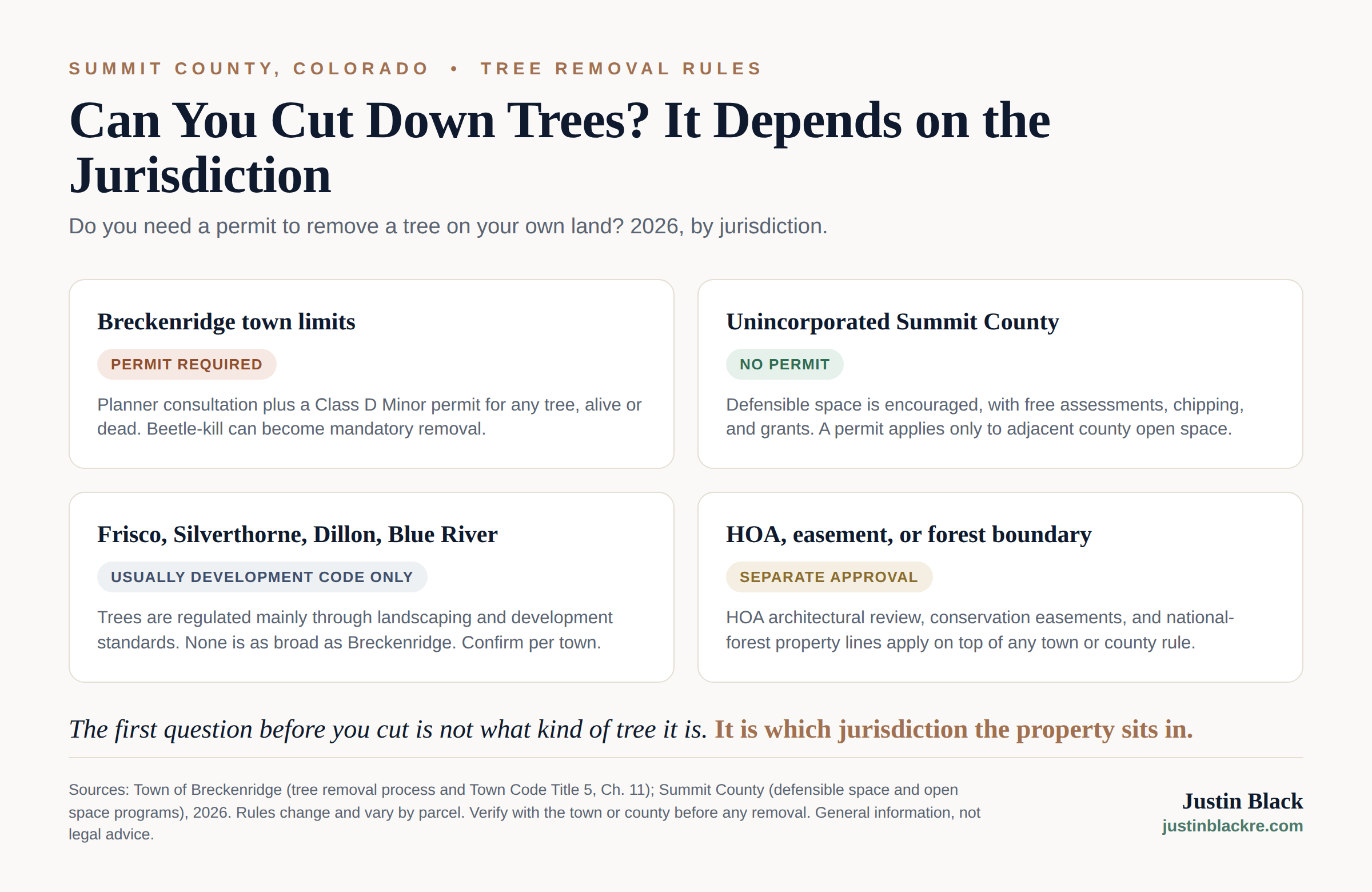
| Where the property sits | Permit to cut on your own land? | The short version |
|---|---|---|
| Breckenridge town limits | Yes, almost always | Planner consultation plus a Class D Minor permit for any tree, alive or dead. Beetle-kill can be mandatory removal. |
| Unincorporated Summit County | No | Defensible space encouraged. Free assessments, chipping, and grants. Permit only to treat adjacent county open space. |
| Frisco, Silverthorne, Dillon, Blue River | Usually only through development or landscaping code | Confirm per town. None publishes a rule as broad as Breckenridge. |
| Any of the above, plus HOA, easement, or forest boundary | Often yes, separately | HOA approval, conservation easements, and Forest Service permits apply on top of local rules. |
Inside Breckenridge town limits
Breckenridge is the strictest jurisdiction in the county, and it surprises people. The town asks you to consult with a Town Planner before removing or cutting any tree, alive or dead, and most removals require a Class D Minor development permit. It's a relatively quick administrative approval, not a months-long process, but it's a real requirement, and it applies even when the reason for cutting is fire safety. The town runs a voluntary defensible space ordinance, but the actual cutting still routes through the Planning Department first.
There's a sharper rule for beetle-kill and infested trees. Under the town code chapter on mountain pine beetles, Breckenridge can inspect a property, declare trees infested, and order the owner to remove them. If an owner doesn't comply, the town can obtain a court order, remove the trees itself, and assess the owner twice the full cost of removal plus administrative fees, collected as a lien on the property like unpaid taxes. So inside town, a stand of dead or infested trees isn't a leave-it-alone situation. It can become a mandatory-removal one.
Unincorporated Summit County
Step outside the town boundaries and the picture flips. On your own private land in the unincorporated county, there's no county permit required to remove trees. The county not only allows defensible space work, it actively encourages it, and backs it with free wildfire mitigation assessments through the local fire districts, free chipping and slash removal for residents who create defensible space, and wildfire mitigation grants for homeowners and HOAs.
The one place a county permit does come into play is when the work extends onto adjacent county open space. The Defensible Space Partners Program is a permit process, reviewed by Open Space and Trails staff and a Colorado State Forest Service forester, that lets residents treat county open space next to their homes. It involves an application, a site visit, a one-year permit, owner-paid costs, and a liability release. Separately, tree rules can still attach through the county Land Use and Development Code during development, when you're building, grading, or subject to required landscaping or sensitive-area protections. That's a construction trigger, not a blanket rule against cutting a tree.
The other Summit County towns
Frisco, Silverthorne, Dillon, Blue River, and Montezuma are each their own jurisdictions with their own codes. In general they regulate trees through their development and landscaping standards rather than through a Breckenridge-style permit for every tree, but none of them is as broad as Breckenridge, and each should be confirmed with that town's community development office for a specific property. If you're weighing a purchase in one of these towns and tree removal matters to your plans, that's a quick call worth making before you write an offer.
The overlays that apply anywhere
These catch owners even where the town or county would allow the cut. HOA covenants are frequently the real gatekeeper, and many Summit subdivisions require architectural committee approval before removing trees. Conservation easements and deed restrictions are common on the large-acreage luxury parcels in the county and can flatly prohibit clearing. Property lines against the White River National Forest matter, because cutting on Forest Service land requires a federal permit and live-tree cutting is generally not allowed. And wetlands, riparian corridors, and steep slopes can trigger review anywhere.
If you're clearing a lot to build, the sequence and the approvals matter even more, and I walk through that in buying land and building in Breckenridge. For how tree cover and fuels tie into a property's wildfire exposure and insurability, see Colorado's wildfire risk score and what it means for your home.
The bottom line
Before anyone puts a saw to a tree in Summit County, the first question isn't what kind of tree it's, it's which jurisdiction the property sits in. Inside Breckenridge, assume you need to talk to Planning and pull a permit for almost anything. In the unincorporated county, you're generally free to cut on your own land, but you still need to check your HOA, any easement, and your property line against the national forest. Get the jurisdiction right first, and the rest follows.
If you're evaluating a specific Summit County property and want to know exactly what you can and can't do with the trees on it, I confirm the parcel's jurisdiction and the current rules before we ever get to closing. You can start with our current Summit County listings.
Tree removal, defensible space, and beetle-kill rules change, and the town and county pages summarize rather than reproduce every provision. Verify the current rules and your property's jurisdiction directly with the Town of Breckenridge, the relevant town, or Summit County before any removal. This is general information, not legal advice.