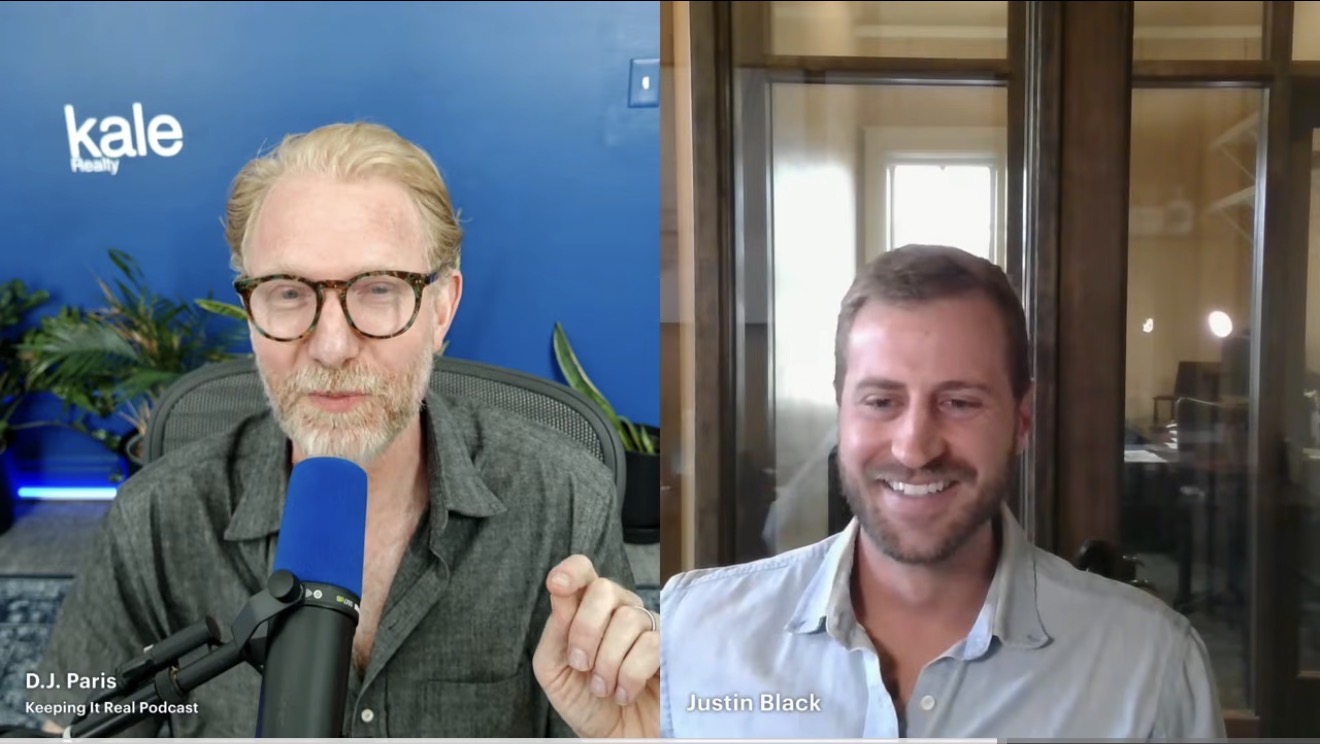
D.J. Paris invited me onto the Keeping It Real Podcast to talk about something I've spent most of this year on. Buyers and sellers are starting to ask ChatGPT and Claude who they should hire, and those tools are handing back names. So I rebuilt my website to be the kind of source those models pull from and recommend.
Prefer audio? Listen on Apple Podcasts or Spotify, watch the full conversation on YouTube, or read the show notes on Keeping It Real.
What we covered
The core idea is simple. Most agents are invisible to AI, not because they're not good at the job, but because nothing on the web tells the model who they are, what they specialize in, and where they work. I walked D.J. through how I fixed that on my own site. It's a question-based content strategy built around the exact things buyers and sellers actually ask, structured so an AI can read it, trust it, and hand me back as the answer.
We also got into how I use AI day to day. I lean on it, Claude especially, to ideate, draft, and audit my pages, and I ended up building the entire site with AI instead of hiring a dev shop. None of that replaces the judgment part of the job. It just lets one advisor produce and maintain the kind of depth that used to take a team.
Then we talked through the offline side of the same idea. My expired-listing process uses FedEx packets, AI-generated market snapshots, and positioning audits, and that system has already turned into multi-million-dollar listings that traced back to AI referrals.
Why this matters for buyers and sellers
More of the people deciding who to hire are starting that decision inside an AI tool. The agents who show up there aren't necessarily the loudest or the biggest. They're the ones the AI can actually understand and trust. That's the real work now, being legible to the systems your next client is already asking.
If you're buying or selling in Breckenridge or Summit County and want an advisor who's ahead of where this is going, that's the standard I hold. You can start a conversation here, or read more of how I think about the market through The Brief.
Full Conversation
Transcript of the episode, lightly edited from the auto-generated captions for readability.
DJ Paris: Hello and welcome to another episode of Keeping It Real, the largest podcast made by real estate agents and for real estate agents. My name is DJ Paris. I'm your guide and host through the show. And today I am beyond excited to talk to our guest. He's an AI guy, I'm an AI guy, and we're going to tell you a little bit about AI, more than you probably already know. This is not about rewriting your listing descriptions or getting social media post ideas. We're going to get into how to feed AI so that you show up in the search results, how our guest is doing that, and how he built his business at an insanely young age.
Our guest today is Justin Black. He's a Real Estate Advisor with LIV Sotheby's International Realty, based in Breckenridge, Colorado, focused on the luxury mountain market across Summit County. He got his start in Colorado Springs helping first-time and Front Range buyers, and over the past decade has built a practice that now runs from about 1 million to 15 million per transaction, with more than 150 million in career sales and several record-setting deals. In 2026, he was named to the National Association of Realtors 30 Under 30, which is a very big deal, and he won the program's Web Choice Award with the most public votes of any finalist, the first LIV Sotheby's honoree and the only Coloradan in the class. He's also RealTrends verified, ranking in the top 0.75% of U.S. agents. What sets his business apart is how he's engineered his online presence to get found and cited by AI, not just ranked by Google, and it's already turned AI into a multi-million-dollar lead source. Follow him on Instagram at jblack.re. He also has a special gift: go to justinblackre.com/agents and he'll send you a no-fluff guide on how to actually get ranked with the LLMs. Justin, welcome to the show.
Justin Black: Hey, thanks so much for having me. I appreciate the intro, that was great.
DJ Paris: I'm excited to talk to you. I live in AI. I'm trying to not build systems as much as I was, because I could get lost in that. I try to tweak my systems constantly, and I'm always so impressed with what AI is capable of today, and what it can't do today but will be able to do in six months. So I want to jump right in. Before we started, our team went through your website, and between the end of June and the beginning of August you published something like 30 different pages. And these aren't blog posts, they're questions. Things like "Should I move to Breckenridge or Park City?" "Can you 1031 exchange a Colorado vacation home?" "Is ski-in ski-out worth the premium?" This wasn't an accident. So tell us what you were actually building.
Justin Black: I appreciate it. For a little context, I'm new to the whole website game as a part of my business. I was on a large team for about six years down in Colorado Springs, in a salesperson role. I still had my license and was an active broker, but I was mostly doing plug-and-play on the transaction deals and building that team's business rather than my own. So I didn't really realize the true value of having a website. The brokers I talked to who had websites mostly used them as a platform to showcase active listings and to have a little credibility, and that was it. It wasn't a lead magnet.
Then I talked with a previous 30 Under 30 out of Lake Tahoe, his name's Cole, and I loved his business. It paralleled mine, Lake Tahoe being similar to Breckenridge, high-end luxury markets, second, third, fourth, fifth homes. I wanted to pick his brain on what was working for him, and he told me that from his website he'd sold 60 million dollars worth of real estate in the past 12 months.
DJ Paris: Wow, that's amazing.
Justin Black: So I thought, maybe this website thing is undervalued in my business. That was the start. I just thought, let me run with this and make it as valuable as I can. I didn't want anything surface level. I always want it deep and better than what's out there. I asked myself, what is a resource that, if someone's looking at this market, is going to blow their mind and give them everything they need? What would I want if I were looking at this market, what questions do I have, and build everything from that place of value. If I'm buying in a different market, I'd hope there's another website like mine, because I don't know those markets, but mine can teach you really quick the best parts of ours, the best neighborhoods, the trends, the STR regulations, you name it.
DJ Paris: I couldn't agree more, and I want to make a big point to our audience. I'll speak for Justin and he can correct me. Justin doesn't even care if you don't visit the website, because you're either searching questions about his area on Google, in which case you may find his site because it's optimized for those questions, or you're doing it on AI, and AI is searching Justin's website to find these answers. So you just want AI to visit it.
Justin Black: Exactly, and that's the exciting part. That's how it worked in real time. I talked to Cole, decided to build the website, and at that point my goal was a valuable, SEO-optimized site that would generate leads. I started this in Q1 into Q2 of this year and saw good traction. But candidly, the approach was to get the website to produce leads, and it snowballed into: I haven't gotten leads directly from my website yet, but I'm getting all kinds of leads from AI that's using my website. So now I'm doubling down on that.
DJ Paris: I'll give you a next-level idea you probably haven't thought of. People are landing on your website, so look up remarketing pixels, I'd start with Meta, Facebook and Instagram. You install a pixel on the page, and when someone who hit your website is on their Meta accounts, you can show them a 15-second video ad. You can target the whole world, since your buyers are everywhere, or stay hyper-local. It's the cheapest marketing you can do, because it only shows to people who've visited your site, and it drips on them. Now, let's go to one of those 30-plus pages you've written, all specifically questions people might ask AI or Google. Once you have the list of questions, how do you structure the article itself? How long, how do you start it, how do you end it?
Justin Black: Gathering the questions is one of the first steps. I looked at my daily practice, what questions am I getting weekly from buyers and sellers. Start there. Then you can take it further and ask your AI: if you were a savvy buyer or seller looking in Breckenridge and wanted to know more about this neighborhood, what are the top 10 or 15 questions you'd have? Run that across different AI platforms and you'll have 50 or 100 questions. If that's not enough, there are sites like AnswerThePublic. You type in "luxury real estate in Breckenridge" and it'll give you another 50 or 100. It's limitless.
As for writing the posts, I leverage AI a lot. I'm usually in Claude at least two to four hours a day, but the majority is through Cowork, so it's running in the background while I do other tasks. I'm very protective of what the AI produces. I make it sound like me, but I'm not saying "write these articles for me." It's: here's the question, here's my personal touch, here's my boots-on-the-ground expert knowledge, what do you think on the angle. So I'm actually writing all of that content. It's not AI-generated, it's AI-assisted.
DJ Paris: I have the same process. I still write it, because it has to be my voice. Even though I've fed Claude thousands of my writing samples and it writes pretty well in my voice, I still thoroughly edit. For everyone listening, if you want to teach AI to speak in your voice, I have a webinar with the exact prompts I use, I'll put it in the show notes. Now let's go back in time. You started at a super young age, I think 19?
Justin Black: That's correct, 19.
DJ Paris: Nobody's giving a 2 million dollar home to a 19-year-old to sell, so joining a team made sense. What's something you tried in your first year that ended up being a total waste of time?
Justin Black: There was a lot that didn't work, but that's trial and error. I'm 19, living in my mom's basement, I've never bought a house or signed a lease, never sold a house, and I'm trying to convince people to trust me as their advisor. Knowing where I was and who I needed to become was a huge step, so joining a team was the right option. A lot of real estate is your sphere, but I was 19 and all my friends were a lender's worst nightmare. I was in Colorado Springs, had been coming up to Breckenridge my whole life. I needed to get in front of a team with a lot of online leads. The first brokerage and team I was on had leads coming in, probably close to 10 a week, so good flow.
I got my reps in, made the calls and follow-up texts and emails, and worked there six or eight months. But I realized there was an issue: I didn't have a closing until about month 10 or 11. I was having great conversations, getting people into the office, getting them to sign agency agreements, and then they could never qualify. I reverse-engineered it and found out that lead source, which they didn't tell us upfront, was from a mortgage broker in Denver, and they were the leads he couldn't qualify. So I was spinning my wheels.
DJ Paris: Let's go back to AI. Before we went live we talked about a couple of deals you got from AI, and you know they're from AI because you ask clients "How'd you find me?" These two account for almost 5 million in transaction volume. And these aren't first-time buyers, these are luxury people who already own other homes and have relationships in play, and they're still finding you. When you got one of those, how blown away were you that AI recommended you?
Justin Black: Completely in shock, honestly. I didn't know if people were really using this to find brokers and then sign with them, or if it was just research. And what level of clientele? It's all of it. It gave me the reassurance that this is a real pillar of business, a real opportunity, and I need to double down. Those two sellers who reached out, one was at 1.8 million, on the market and under contract now, and the other is a 3 million dollar listing here in Breckenridge, going on the market shortly. Both were come-list-me calls, not "I'm looking in six or twelve months." They said, "I'd like my home on the market within 30 days, can you come take a look?" I could not believe it.
DJ Paris: Another content idea, and this is something you could do, maybe not super high converting, but top three coffee shops in Breckenridge, the best gourmet grocery store, where are the infrared saunas, the cold plunges. People ask AI every question they'd ask Google, so it doesn't just have to be real estate. Okay, so, I guarantee there's an agent listening who's 12 years in and says this is attribution theater, people would have found you anyway. Talk to that person. What would convince them this is viable?
Justin Black: I love that, because it was a thought I had building this out. I moved to Breckenridge two and a half, three years ago, and I've only been independent with Sotheby's since March of this past year. I've been in the business 10 years, but now I'm learning how to build this thing myself. I'm the young buck. In a town like Breckenridge there are brokers who've been selling 30, 40, 50 years with a massive book of business, and I'm trying to get cited by AI. When you break my 150 million down, maybe 20 of that is up in Summit County and the other 130 is in Colorado Springs, but I'm still getting cited and ranked by those AI platforms because I know how to talk to them. So to the person with an established business asking "is this for me?" 100%. You just need to put in a little time so you can tell the algorithms what they need to know, and they can bring you another five or ten million in business each year. You set it up once.
DJ Paris: For everyone not sure if they're showing up in AI results, what's the best way to run their own clean search?
Justin Black: Some of the ones I've shown up for are "top luxury brokers Breckenridge, Colorado," or "who are the top brokers." You can open an incognito window, or build a new free Claude account without telling it your whole life story, and ask "who are the best brokers in Breckenridge." But then I take it further. I work with Claude in Cowork and say, I want to understand where I'm showing up on these prompts, give me the top 15 or 20 prompts buyers and sellers are asking for Breckenridge and run them across all the AI platforms. I watch it open windows, Gemini, Perplexity, ChatGPT, and it puts together a full audit of where I'm ranking, what pages are getting cited, and where the room for improvement is. That's your task list for the week.
DJ Paris: While we were talking I typed in "who are the best luxury brokers in Breckenridge, Colorado," and you absolutely show up. It gives a couple of names, of course, but you're right there, and it doesn't know I'm talking to you. That's incredible. You said something profound. Somebody once told me, when I was trying to figure out how to write a great query, "just ask AI what the best query is, because AI knows itself better than anyone." So you can ask AI what people search for who are looking to buy in an area, the real estate and non-real estate questions, and how to write the queries. A great tip: whenever AI gives you a process, even if you like it, say "stress test this, tell me what's strong and weak and how to make it better," and it'll do it. If I were practicing in Logan Square in Chicago, I'd ask, what are people thinking about moving here writing into Google and AI before they decide on a realtor? Each of those is an article.
Justin Black: I love that. And for context: I had zero background in AI, websites, coding, or graphic design prior to January of this year, and I learned everything by asking AI. That whole website was built 100% through Claude. The best way to do it is to find your top two, three, four competitors in the country or your local market, put them into Claude, and say "here are the top websites based on design and SEO, build my website in line with those."
DJ Paris: Wait, did I hear you correctly? justinblackre.com, which is a beautiful, minimal, functional site with great UI, was entirely built by AI?
Justin Black: 100%.
DJ Paris: That is incredible. It's mind-blowing where it's gone.
Justin Black: The high level is starting with those prompts, find my three competitors, I like these sites, help me build mine. Then you're in Claude giving that prompt, it spits it out, and you copy and paste into Claude Code, which builds it. I don't know how to code, I don't know what half that mumbo jumbo is, but you screenshot it back to Claude and they just talk, and you manage it. That's been the last six months.
DJ Paris: I saw your website and immediately thought it was a Luxury Presence site, which is one of the highest-end website builders for realtors in the country, and that's the highest compliment I can give.
Justin Black: Thank you, I appreciate that. I used a lot of their websites to model this after.
DJ Paris: You must have, because this is incredible. AI built that website, and he fed it competitor sites and sites he liked, and it did it for him. And remember, he's got his exact structure as a download for our audience at justinblackre.com/agents.
Justin Black: Quick note: I've taken so many courses and downloaded so many guides over the years, and 90% of them are fluff where you scan to maybe get one tangible item. That's not how I operate. I'm black and white on giving the value, actual things you can do this week to start getting cited and build that foundation.
DJ Paris: What are agents getting wrong about AI right now, things they think are helpful but aren't?
Justin Black: Nine times out of ten, when I talk to brokers about AI, it's "yes, I use it to write my listing descriptions." That's where it starts and ends. It can help with that, but that's scratching the surface. I'm at a cool part in my business: I've been in it 10 years, but now I'm finally an independent broker with the freedom to build a leg of business, say, going after expired listings, which is a huge part of my business. I'll tell Claude, here's my current process, review it and tell me how to improve it, and it does.
One note, since you mentioned pixels: the most underleveraged use of pixels I've found is QR codes. A lot of people farm a neighborhood with just their website on the mailer, and someone has to type it in, which you can't track. But if you have a QR code with a pixel, and they scan it for a home valuation, or they came in from a just-listed or just-sold postcard, or my expired packets, I now know that and they start getting hit with my ads. That was an AI idea Claude fed me. Every part of your business, run it through AI to see what you can do better.
DJ Paris: So this is basically what you've built that's netted you a minimum of two unbelievable deals, on a very small budget. What did this actually cost you, in dollars, hours a week, and weeks?
Justin Black: As far as hard costs, I'm on Claude's highest tier because I burn through a lot of tokens, so I think that's 200 a month. You could do it slower with a cheaper option. Then the domain, 30 or 40 dollars a year. Very minimal. I considered Luxury Presence, but they were north of 5,000 dollars for the build I wanted, and my understanding is you lease the website, so if you stop paying you may not keep it. I own my website 100% now. To get a site to my degree, you could probably do it in 30 to 60 days leveraging Cowork, maybe four or five hours a day, but it's really 10 or 15 clicks a day while Cowork works in the background, so you're still doing your normal business.
DJ Paris: What are you doing every week to maintain and keep feeding the LLMs? Are you creating new articles every week?
Justin Black: I am, and there's a cadence I want to hit. Sometimes I'm in a conversation with a client or broker, they ask a question, I check my site, I don't have that page, so I make it on the spot that day, which takes 20 or 30 minutes. The framework I recommend is three tiers: foundation, growing and scaling, and automating. I'm at the point where this is largely automated. I have a scheduled task in Claude where every Monday I get a report on what local news and publishers found in our area, tailored to my niche, so a new development, a change in STR regulations, or property insurance, since fires have been a big problem in Colorado. At 7 a.m. Monday I get an email from Claude with the top 10 stories and which I want to run that week, and I run three, assisting on how to tailor them. It's about 80% automated.
DJ Paris: You wrote a piece called "Your Listings Didn't Fail, Your Positioning Did." When you pick up an expired, what do you change in the first 10 days, and in what order?
Justin Black: Expireds are the lowest-hanging fruit out there, but a lot of people just call and text. That might work in some markets, but mine being high-end luxury 5 to 10 million properties, I put together a physical package with my full listing presentation, showcasing previous listings. I do a cinematic and a lifestyle video, one long-format and one short, with a page of QR codes so they can see my previous work. I also write an audit letter for each listing: I look at how they listed the property, their marketing, media, and copy, find little opportunities, and give recommendations, in a tone where I'm not knocking the other agent. I'll say, here's some opportunity, and I think it may have been a positioning issue versus a pricing issue, which is the case a lot of the time. That's a great way to get in the door, and it's not as confrontational as calling at 9 a.m. the day after their listing expires.
DJ Paris: One vendor tracked 78,000 expireds in a single week this past April, up 83% from two years ago. Most agents look at that and think pricing, but you say positioning. In practice, what's the difference?
Justin Black: It can be a bit of both. Pricing is a factor, but maybe not as large as they think. A lot of expireds tell me, "You're with Sotheby's, great brand, international reach, that reach is going to help me sell for the same price I tried last time," and sometimes I don't have a magic wand. But the deeper difference is the level of presentation and marketing. And to your intro question about the Front Range: in Colorado, if you're coming from the east toward Kansas and heading west, you hit Pikes Peak, and that mountain range separates the plains on the east from the mountains on the west. Fort Collins, Denver, Colorado Springs are the Front Range, and those are a lot of our feeder markets up to Breckenridge. A good 40% of people who own a part-time home in Breckenridge live in Colorado Springs or Denver. I'm a member of three MLSs, Denver, Colorado Springs, and Breckenridge, so my listings get triple the exposure versus a single MLS.
DJ Paris: For agents working a list of expireds, what's the first touch look like?
Justin Black: I've tried all approaches, calling, texting, a casual approach, and had some success. But 90% of my expireds business is spent prepping the package: the audit letter, my full presentation, and a market snapshot, not a market analysis, because I don't want to lead with "your pricing is off." The snapshot has months of inventory, the absorption rate, your pricing segment. I put all of that together and then they call me. I don't follow up on my packets, I let them do their job. I got a call the other day from a Colorado Springs expired around 1.5 million: "Got your packet, super impressive, the most thorough packet I've seen, no one else did this, they all just called and I didn't give them the time of day. Life changed, we're no longer selling, but I can tell how much effort you put in, do you want to come pick it up?" What a compliment from an expired.
DJ Paris: How are you actually getting the packets to them, hand delivering, mailing?
Justin Black: FedEx. In the mountain markets we have a lot of PO boxes, and when is someone going to be in town on their fourth or fifth home, so it goes to their actual address on the tax record, not the property address, 90% of the time, dropped on their doorstep within three days of the property expiring. There's a light texting campaign around the package. The first text, the morning it expires if it's one I want to go after, is basically, "I saw your property came off the market, I'm putting together a high-level in-depth packet on market updates, I just wanted to confirm this is the best address to mail it to." A lot of times they say "yes, looking forward to it." Sometimes they say "we're going to relist with our aunt or uncle," and then I don't send it, which saves me time. The next touch is the day it's delivered: "I was tracking the package, it should have delivered today, I'll give you time to review it, I'm here for any questions." It leads around the value and lets them lead the conversation.
DJ Paris: Are you using AI to put the packages together?
Justin Black: For a couple of custom pages, yes. The market snapshot runs through a custom Cowork project in Claude, pulling market data from the MLS based on how I've told it, property data within the last six months within two miles of the property, and it spits out that one page I print. I'm writing the majority of the audit letter, using AI a little to template it and put a letterhead on it. The rest is my traditional listing package.
DJ Paris: For-sale-by-owner and expired leads get sold all over the country and these people get hammered on the phone and email. How many of them get a FedEx package like yours? I'm guessing you're the only one.
Justin Black: Only one, maybe one or two others, if that. If you started this in your market there's a good chance you're the only one, because everyone's calling and texting, and the sellers tell me that: "I appreciate you respecting my situation and giving me time. There were 20 other agents that called me this morning."
DJ Paris: The FedEx thing is brilliant, because everybody opens something from FedEx, we think it's important. It costs an extra 10 bucks, but for one commission you could send 500 and only need one to hit. And for the rest of us, think about it for farming: close a property in a neighborhood, look up the neighbors, and FedEx them, "I just sold so-and-so's home, I'd love to tell you what I think your property is worth, even if you already have an agent, I'd just love to be your backup." You'd be shocked how many reach out. Okay, last question, more about your age. You got your license at 19 right out of high school in Colorado Springs. What did that 19-year-old have that you have not lost?
Justin Black: It's the drive and the hustle. A motto I love: if you're the smartest in the room, you're in the wrong room. At 19 I was naturally in that spot, I'm in a brokerage knowing nothing about real estate, so I just kept evolving, trying to outgrow each room and go to the next. It's doing more reps than others are willing to do. It's funny how it evolved, I built my business on online leads, but we were on a Zillow Flex team selling 30, 40, 50 homes a year, and I felt, if someone else was handed this lead they could probably sell it too. I wanted to generate something myself. So I went door knocking, 200 or 300 doors a day around my open houses, new listings, and just-solds, until I started generating business. That's a lot of reps, and there are smarter ways, but I wanted to cultivate a cold lead from knocking on a door all the way to closing, and that happened several times and felt really good.
DJ Paris: It builds resilience, because you're building a failure machine. You're not going to get 15 or 20 people saying "let's work together" from 200 doors. But you're showing people you're willing to do something hard, and getting them in your database. You can always say, "I'm not here to become your realtor today, you probably have one, but I work with a lot of people in this neighborhood and I'd love to send you a no-obligation valuation." Almost no one door knocks anymore. People say it's creepy, and I say it's only creepy if you're a creep. I interviewed a top producer who only door knocks, at million-dollar homes, and he's an architecture junkie, so he researches the property, knocks, and says, "I'm not here to bother you, I know everything about this house, I know the architect, I'd be honored if you'd show me the inside." People are flattered. At the end he says, "I know you're not looking to sell, and I won't try to make you my client, but if you ever do sell, I can find a buyer, would you please just call me, list with whoever you want, I'll find the buyer." He almost always gets the listing.
Justin Black: I love it. There are a million ways to do it. Calling and texting can work, but there are a lot of other ways, like sending a packet by mail, which is guaranteed to get opened, and then presending a text: "Just so you know, I'm sending this out, do I have the correct address? No obligation." Getting somebody to say yes, so they know it's coming. Then, "I saw it was delivered, take a look, let me know what you think, have a great day." Most of the time people are thrilled you did it.
DJ Paris: I want everybody to download Justin's AI helper on how to structure content, feed the large language models, and show up in AI searches. And I have homework for everyone: open your AI of choice, ask it to recommend the best real estate agent in your market for whatever you specialize in, screenshot whatever it tells you, then go write a one-pager on your website that answers one real question your last client actually asked. If you struggle, have AI write the first draft and edit it. Put it on your website. That's the first step to getting the LLM to notice you, and then rinse and repeat. On behalf of our audience, thank you, Justin. His website to download the AI guide is justinblackre.com/agents, and follow him on Instagram at jblack.re. If you have clients who are skiers, or who move to Colorado when they retire, or vacation there, this is the guy to talk to, he'll be a great referral source and he sends referrals out too. Congrats again on the 30 Under 30. Thanks to our audience, and we'll see everybody on the next episode.
Justin Black: Thanks so much for having me on.