
In a county where almost every jurisdiction now caps short-term rental licenses, Keystone is the exception. It became Colorado's newest town in 2024, took over its own short-term rental program, and chose not to cap. The result is the most permissive licensing environment in Summit County: no cap, no waitlist, and no annual limit on nights or bookings. For a buyer who needs a reliable rental path, that's a meaningful advantage, and it's the opposite of the Breckenridge zone system. Here's how Keystone works, and the one thing you have to confirm before you count on any of it.
Can you short-term rent in Keystone?
Yes, and more freely than almost anywhere else in the county. Any property inside the Town of Keystone can be licensed and rented short-term. As of 2026 there's no cap on the number of licenses the town issues, no waitlist, and no limit on how many nights or bookings you take in a year. You need a Town short-term rental license and you have to follow the operating rules, but you aren't competing for a scarce permit the way you're in Breckenridge or the unincorporated county.
Keystone short-term rental rules at a glance
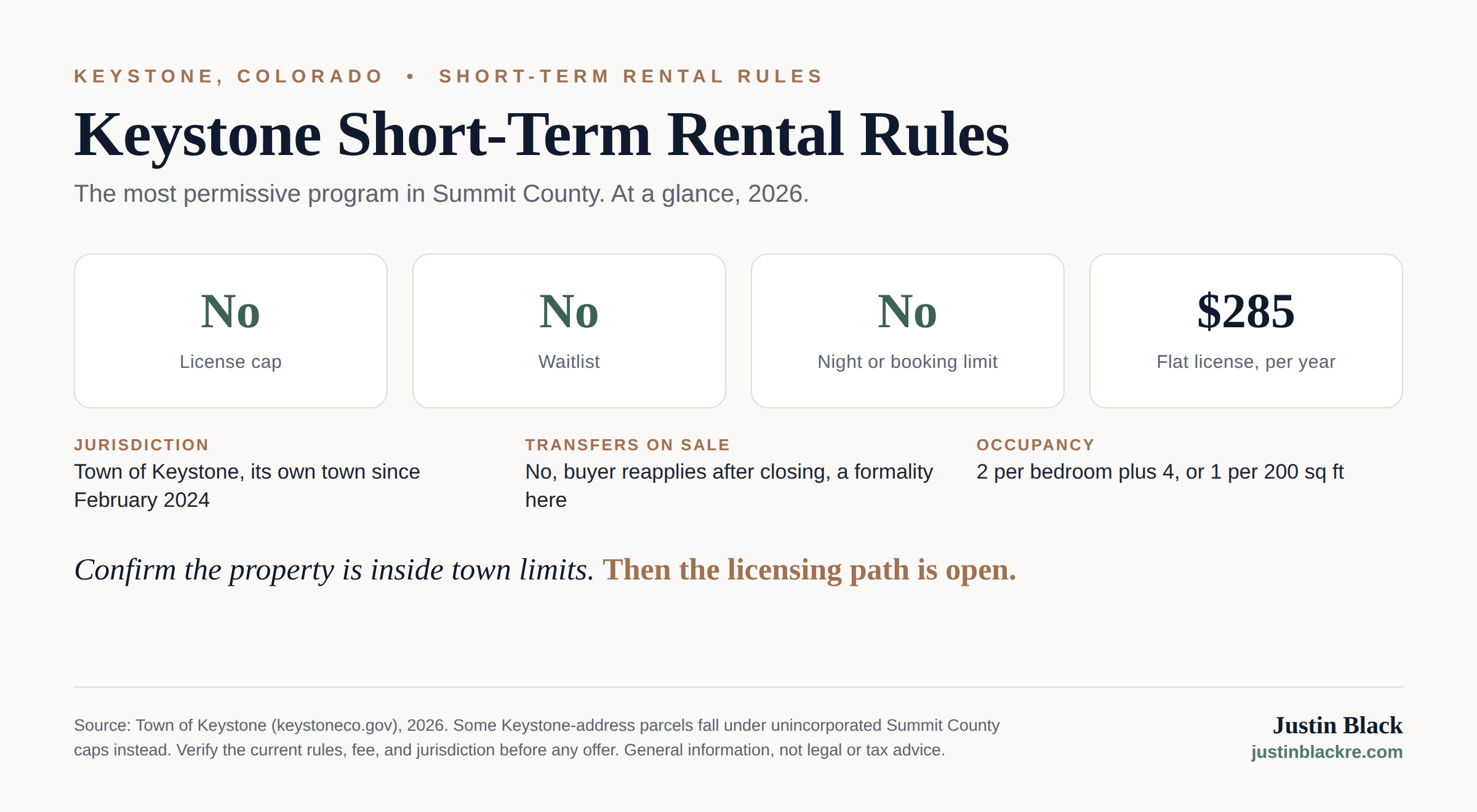
| Rule | Keystone (2026) |
|---|---|
| License cap | None |
| Waitlist | None |
| Annual night or booking limit | None |
| License fee | Flat $285 per year |
| Transfers on sale | No, buyer reapplies after closing |
| Occupancy | 2 per bedroom plus 4, or 1 per 200 sq ft, whichever is greater |
| Jurisdiction | Town of Keystone, its own town since February 2024 |
Why Keystone is different from the rest of Summit County
The story is jurisdiction. Keystone incorporated as its own town in February 2024 and took over short-term rental licensing and enforcement from Summit County later that year. As a new town, it wrote its own rules, and it decided not to cap. That puts it in a small group of freely licensable Summit County markets.
The contrast is stark. In Breckenridge, the town splits every address into one of four license zones, two of which are at cap with multi-year waitlists. In the unincorporated county, the Neighborhood Overlay Zone limits a licensed home to 35 bookings a year. Silverthorne caps licenses by area and bans them outright in its workforce zone. Keystone, so far, does none of that. For an investor, that difference is the whole point: in Keystone the licensing path is open, and it's the property and the numbers, not a waitlist, that decide the deal.
Does the license transfer when you buy?
No. Like everywhere in Summit County, the Keystone license is tied to the owner, not the address, so it's surrendered when the property sells and the new owner applies fresh after closing. The difference is what that reapplication means. In a capped Breckenridge zone, reapplying can mean years on a waitlist or no license at all. In Keystone, with no cap and no waitlist, it's a routine filing you complete after you own the home. A listing that markets a strong rental history is still describing the seller's license, but in Keystone you can replace it without the scarcity risk.
The one thing to check first: is it actually in the Town of Keystone?
This is where deals go wrong. Not every property with a Keystone mailing address sits inside the Town of Keystone. Keystone addresses use the Dillon post office and the 80435 zip code, and some nearby parcels fall under unincorporated Summit County rather than the town, which means the county's capped overlay rules and the 35-booking limit apply instead of Keystone's open program. The permissive rules on this page are a Town of Keystone benefit. Before you rely on them, confirm the specific parcel is inside town limits, not a county address that happens to say Keystone. It's the first thing I check on any Keystone rental purchase.
What a Keystone rental earns
Keystone is a real rental market, anchored by the River Run gondola base, the new Kindred luxury residences, and ski-in inventory. On paper, market-wide averages run lower than Breckenridge, in part because the analytics platforms average in many part-year and lightly-used listings, so a headline average understates what an actively managed ski-in unit produces. As with everywhere, the gross figure is the least useful number in the conversation. What matters is the net after the town license, taxes, management, and operating costs, and whether the specific property fits your plan. We work that through in the honest math on a Colorado vacation rental, and the Breckenridge income-by-bedroom ranges are a reasonable directional starting point for comparable Keystone inventory.
The bottom line for Keystone rental buyers
Keystone is the rare Summit County market where the short-term rental question has a simple answer: yes, you can, without a cap or a waitlist. That makes it one of the cleaner places in the county to buy with rental income in the plan. The two things to get right are confirming the property is actually inside town limits, and running the net math rather than the gross. Get those right and Keystone's open licensing does the rest. For how the whole county compares jurisdiction by jurisdiction, see our Summit County short-term rental rules by town.
If you're looking at Keystone with rental income in the plan, I confirm the jurisdiction, the licensing path, and the net math before we ever write an offer. You can start with our current Summit County listings.
Short-term rental rules, fees, and dates in Keystone change and the town's program is still new. Verify the current rules, fee, and your property's jurisdiction directly with the Town of Keystone before any purchase or licensing decision. This is general information, not legal or tax advice.